Message To African (Black) People - We Must Be Organized Before We Can Be Unified!

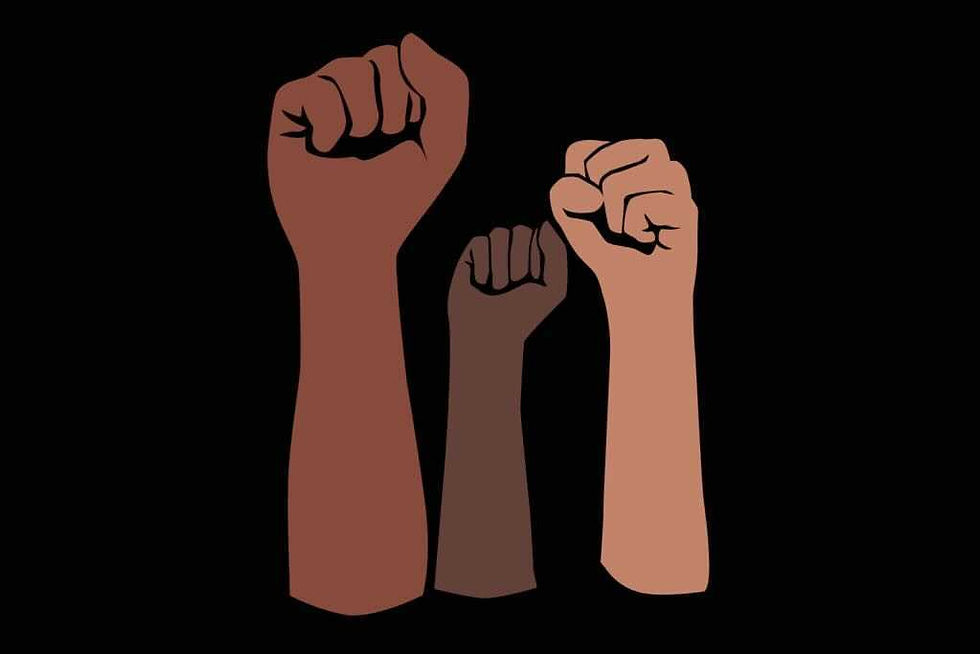
One of our main problems as a people is that we are disorganized. Kwame Nkrumah sagaciously stated, “Unity presupposes organization.” This means that people cannot be unified until they are first organized.
Many Black people correctly profess that the reason we cannot make any sustained progress in amerikkka is that we need unity. But, when you ask them if they are in an organization that is fighting for justice, they’ll give you that look, ‘like a deer caught in the headlights’, and tell you ‘no’. Either consciously or unconsciously, if this is you, what you are engaged in is the practice of disunity. And anytime you profess the correct thing to do but practice the antithesis of what you profess, you are working against your own interests and the interests of your people because of your inaction.
Those of you who think voting 1 day in political elections every 2-4 years is the only tactic necessary to facilitate the unification and liberation of Black people are in for a rude awakening because, by itself, voting will never bring to fruition what you desire. The Voting Rights Act became law in 1965. If we could have secured our unification and liberation through voting alone, we would certainly be unified and free as a people by now. We need organization to achieve these important goals.
No one can deny that Black people, along with other progressive people across this country, elected the first African (Black) in amerikkka as POTUS in the person of Barack Obama. We even re-elected him. As great as these political victories were, I ask you one question: “Were the masses of Black people unified and liberated as a result of Barack Obama’s presidency?” Any intelligent analysis of the social-political-economic data will reveal that the answer to this question is “No”! Therefore, utilizing the vote 1 day every 2-4 years in political elections, as the only tactic, will never unify and set Black people free. The political system in amerikkka operates 365 days a year, 24/7. So how in the hell does your participation in the political process, limited to voting 1 day every 2-4 years, give you any real power? Mao Zedong powerfully punctuated the point that “Politics is war without bloodshed while war is politics with bloodshed.” (1,1) To win a war, you must utilize all the tactics/strategies at your disposal and be willing to fight until the victory is won.
The aforementioned example (the election of Barack Obama to the U.S. Presidency), along with many other examples throughout our history in amerikkka, validates Nkrumah’s thesis. Personally, I view the vote as only one tactic among many at our disposal to achieve the unification and liberation of our people. In addition, I view the vote as a tool for organizing our people.
Now, some of you will say you deal in history and facts, and my argument thus far hasn't convinced you. You still believe that voting by itself is the only tactic that will accomplish the aforementioned goals. I hear your argument. However, I say to you, we have more Black City Councilpersons, Mayors, State Representatives, State Senators, U.S. Congresspersons, and U.S. Senators that hold political office right now than at any time since our sojourn began in this wicked country. white people didn’t vote all these Black officials into office. Black folks led the efforts to elect these officials and accounted for a large share of the votes. So it is crystal clear that a large number of Black folks are exercising their franchise via voting. In addition, our votes were critical in electing many past presidents, including Barack Obama. Therefore, it is fallacious even to suggest that Black folks aren’t voting in significant numbers, juxtaposed next to the voting patterns of other demographics. “According to the voting data collected in amerikkka related to Presidential elections between 1978 and 2024, Black people have the highest voting rate (59.6%) of all ethnic minorities and are second only to the voting rate of whites (70.5%).” (2,1) However, with more elected Black politicians in office today than at any other time previously in U.S. history, the social-economic data indicates that we are worse off today than we were in the 1960’s. This confirms my thesis that voting alone is not the answer to unifying and liberating our people.
Malcolm X demonstrably declared, “Unity is not about agreeing on everything in the Black community. Unity is standing together on what matters most to the Black community. But unity must be built on respect, honesty, and purpose; not just words because words alone will not hold people together.”
Unity is the foundational element for survival and revolutionary change against oppression. As members of the New Afrikan Black Panther Party (NABPP), our perspective on unity is not merely centered on ethnic solidarity, but on organizing to create power, resistance, and community support. We view Black unity as a necessary component of collective self-defense and survival against oppression and systemic violence. Authentic unity is demonstrated through practical action, such as the NABPP’s free food distribution program, clothing program, and political education initiatives.
In a 1970 essay, Dr. Huey P. Newton emphasized that the revolutionary struggle should not exclude anyone based on their sexuality, famously stating that "the homosexual could be the most revolutionary" of all oppressed people. In his view, Black unity was not just about solidarity, but about creating a "system of survival" to combat the marginalization of Black people, a challenge he felt deeply growing up.
The Black Panther Party (BPP) formally adopted Revolutionary Intercommunalism as its guiding ideology around 1970–1971. Before discussing this ideology, it is essential to first lay the foundation by examining Black Nationalism and Revolutionary Nationalism.
Marcus Garvey was a key figure in Black Nationalism, promoting the idea of a unified, independent Black nation, particularly through the concept of returning to Africa. His movement, the Universal Negro Improvement Association (UNIA), aimed to foster racial pride, economic independence, and self-determination among people of African descent worldwide. Garvey's influence extended to the Black Power movement and continues to inspire movements for social justice and Pan-Africanism.
Garvey's ideology blended "Pan-Africanism, which emphasizes the unity and solidarity of all people of African descent" (3,1), with Black Nationalism, which seeks self-determination and independence for Black people.
"Garvey advocated for the repatriation of African Americans to Africa" (4,1), establishing the UNIA headquarters in Harlem in 1917 and aiming to create a powerful Black nation in Africa.
Garvey believed that economic self-sufficiency was crucial for Black Liberation, and he promoted Black-owned businesses and industries through organizations such as the Black Star Line.
Garvey's ideas significantly influenced later Black Nationalist movements, including the Nation of Islam, Malcolm X, and the Black Power Movement of the 1960’s.
Black Nationalism is an ideology that expresses the need for Black People to control the social-cultural institutions in their community, the economy of their community, and the politics and politicians in their community.
From its inception, the BPP embraced Revolutionary Nationalism because it combines elements of Black Power and revolutionary socialism. In addition, the BPP adopted it because it emphasized collectivism and people power to address the community’s needs. Revolutionary Nationalists maintain that African Americans cannot achieve liberation within the existing political and economic system. Therefore, they call for revolution to rid society of capitalism, imperialism, racism, and sexism. It is this call for revolution that distinguishes Revolutionary Nationalism from Black Nationalism. For those looking to join a revolutionary organization, remember that just because an organization has “Revolutionary” in its name, that does not mean that it is a revolutionary organization. If the organization’s political ideology explicitly calls for revolution to replace the existing unjust political/economic system with a new, just political/economic system, it is a revolutionary organization. If this is not the case, the organization is not a revolutionary organization.
In his book entitled “Revolutionary Suicide”, BPP Co-Founder, Dr. Huey P. Newton stated, “I do not think that life will change for the better without an assault on the Establishment, which goes on exploiting the wretched of the earth. This belief lies at the heart of the concept of revolutionary suicide. Thus, it is better to oppose the forces that would drive me to self-murder than to endure them. Although I risk the likelihood of death, there is at least the possibility, if not the probability, of changing intolerable conditions.”
"Intercommunalism is an ideology that was adopted by the Oakland chapter of the Black Panther Party after its turn away from revolutionary nationalism in 1970. Intercommunalists believe that most forms of nationalism are obsolescent because international corporations and technologically advanced imperialist states have reduced most nations down to a series of discrete communities." (5,1) Dr. Huey P. Newton asserted the analytical assessment that “The ruling reactionary circle, through the consequence of being imperialists, transformed the world into what we call 'Reactionary Intercommunalism.' They laid siege upon all the communities of the world, dominating the institutions to such an extent that the people were not served by the institutions in their own land. The Black Panther Party would like to reverse that trend and lead the people of the world into the age of 'Revolutionary Intercommunalism.' This would be the time when the people seize the means of production and distribute the wealth and the technology in an egalitarian way to the many communities of the world.” (6,1)
Malcolm X was correct when he sagaciously stated: "There can be no black-white unity until there is first some black unity. We cannot think of uniting with others, until after we have first united among ourselves" (7,1).
When I talk about the task of uniting our people, I always encounter a few Black individuals who possess a negative mindset and who in many instances are not doing anything whatsoever to advance our people forward, who will say, “You’ll never be able to unite Black people because of the differences in our religions, how we view ourselves (Foundational Black Americans vs Pan-Africanists), socio-economic class, etc… “
Once again, the sagacity of Brother Malcolm illustrates the irrefutable idea that guides us in our work when he powerfully proclaimed, “We all catch hell for the same reason. We all catch hell from the same man. He doesn't look at you as a 'house negro' or a 'field negro.' He doesn't look at you as a 'civil rights' negro or an 'integrationist' negro. He calls you a nigger."
Instead of viewing our superficial differences through a magnifying glass, we need to focus on what we have in common. Once again, Brother Malcolm empowers us when he stated, “We have a common enemy. We have this in common: We have a common oppressor, a common exploiter, and a common discriminator. But once we all realize that we have this common enemy, then we unite on the basis of what we have in common. And what we have foremost in common is that enemy - the white man. He's an enemy to all of us. I know some of you all think that some of them aren't enemies. Time will tell.” (8,1)
Brothers and Sisters, we must be resolute in our understanding that power doesn’t listen to requests. Power responds to pressure. And when a united people apply social-political-economic pressure together, history moves.
We must first organize ourselves so that we can be unified in our struggle to combat white supremacy, capitalism, and an out-of-control fascist amerikkkan government. Organization is the prerequisite for our unification. And unification is the precondition for our liberation. Organization decides everything. Disorganization decides nothing but guarantees the perpetuation of the status quo. It is the masses that make history, not individuals. Therefore, if you’re not already in an organization fighting for justice, I encourage you to join the New Afrikan Black Panther Party or another organization that does. If there are no existing organizations aligned with your values, I encourage you to create a new one that will fight for justice.
Marinate on That!
Ready For Revolution
All Power To The People!!!
Sources
“On Protracted War” by Mao Zedong, Selected Works Vol II, May 1938, pp. 152-53
"How does voter turnout in the US differ by state, age and race?" by USAFacts team, USAFacts, August, 2025 - https://usafacts.org/articles/how-many-americans-vote-and-how-do-voting-rates-vary-state/
"We Need More Afro-Latinx Visibility in Media" by Nydia Simone, PS Entertainment, April 20, 2023 - https://www.popsugar.com/entertainment/we-need-more-afro-latinx-visibility-in-media-49134187
"Marcus Garvey (Jamaican Activist) - Biography and Garveyism" by Stone Palmer, Biography Host, February 14, 2025 - https://biographyhost.com/p/marcus-garvey-biography.html
"Intercommunalism" - Wikipedia, - https://en.wikipedia.org/wiki/Intercommunalism
"Huey P Newton’s Speech at Boston College 18th November 1970" Speech by Huey P. Newton, The Facts of Whiteness, November 18, 1970 - https://thefactsofwhiteness.org/huey-p-newtons-speech-at-boston-college-18th-november-1970/
"Malcolm X: A Declaration of Independence" Speech by Malcolm X, ICIT Digital Library, March 12, 1964 - https://www.icit-digital.org/articles/malcolm-x-a-declaration-of-independence-march-12-1964#:~:text=Malcolm%20X:%20A%20Declaration%20of,Independence%20(March%2012%2C%201964)
"Message To The Grass Roots" Speech by Malcolm X, History Is A Weapon, November 10, 1963 - https://www.historyisaweapon.com/defcon1/malcgrass.html


Comments